- Introduction
- Key Takeaways
- Contemporary Desert Chic
- How to execute contemporary desert chic in a high-rise:
- Sleek Urban Minimalism
- Key elements of minimalist Strip condo design:
- Art Deco Revival
- How to keep Art Deco revival feeling residential:
- Indoor-Outdoor Flow
- What indoor-outdoor design requires in a Strip high-rise context:
- FAQs
- Ready to Elevate Your Las Vegas Strip Condo Interior Design?

Introduction
A Las Vegas Strip condo presents a specific design challenge: floor-to-ceiling glass, open floor plans, panoramic city or mountain views, and relatively compact square footage that needs to feel generous. The right interior design style works with all of those constraints rather than against them. The wrong one fights the architecture and makes a premium unit feel like an afterthought. Here are the styles that translate best to Strip high-rise living — and what each one requires to execute well.
Key Takeaways
The view is the anchor of any Strip condo interior — every design decision should support it
Low-profile furniture and clear sightlines are essential regardless of the style you choose
Contemporary desert chic is the dominant aesthetic in Las Vegas luxury high-rises right now
Finishes and materials have a direct impact on resale value in this market
Contemporary Desert Chic
In a Strip condo, this style works because it is warm enough to feel residential rather than hotel-like, and restrained enough to let the view lead. The palette does not compete with the neon and city lights outside — it frames them.
How to execute contemporary desert chic in a high-rise:
Warm neutrals on walls and large upholstered pieces — avoid stark white, which reads cold against desert light
Natural stone — travertine, limestone, or honed marble — in kitchens and primary bathrooms
Low-profile sofas and chairs that sit below the window line and keep sightlines open
Organic shapes in accent pieces: rounded vases, sculptural lighting, curved coffee tables
Sleek Urban Minimalism
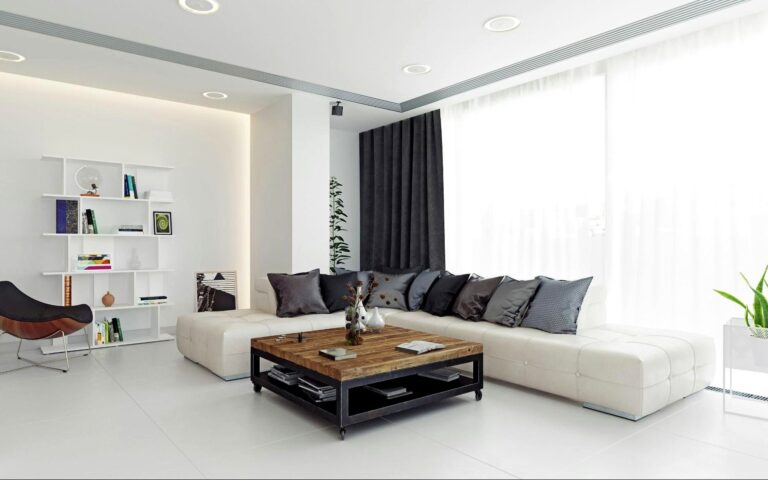
This style suits Strip high-rises because the architecture is already doing a lot of the work. Buildings like Waldorf Astoria Residences and Veer Towers were designed with minimalist sensibility — straight lines, floor-to-ceiling glass, refined hardware. An interior that matches that precision feels intentional and cohesive.
Key elements of minimalist Strip condo design:
White or warm greige wall palettes with high-gloss or matte-lacquer cabinetry in the kitchen
Integrated appliances that disappear into cabinetry — sub-zero refrigeration, concealed dishwashers
Furniture with clean geometric profiles, no ornamentation, and tight upholstery
Built-in storage along underused wall runs — hallways, entry alcoves, flanking the fireplace wall
Art Deco Revival
The elements that work in a Strip condo context are the geometric patterns, the jewel-toned accents, the brass and lacquered finishes, and the sense of drama in lighting. A velvet sofa in deep teal or emerald, a sunburst mirror, pendant lighting with an architectural profile, and a lacquered bar cabinet can anchor the aesthetic without overwhelming the space.
How to keep Art Deco revival feeling residential:
Ground the palette in neutrals — charcoal, ivory, warm black — and use jewel tones as accents rather than dominants
Geometric pattern in rugs and throw pillows rather than wallpaper or upholstery throughout
Statement lighting: a sculptural pendant or a pair of wall sconces with brass detail carry significant design impact
One or two strong furniture pieces rather than a room full of period references
Indoor-Outdoor Flow
The indoor-outdoor approach treats the balcony as a room, not an afterthought. Weather-resistant materials that match the interior palette, comfortable seating scaled to the space, and lighting that allows the terrace to function after dark are all part of the execution.
What indoor-outdoor design requires in a Strip high-rise context:
Exterior furniture in powder-coated aluminum or teak that coordinates with interior finishes
Outdoor rugs that define the seating area and add warmth to concrete or tile balcony surfaces
String lighting or wall-mounted exterior sconces for evening use
Window treatments on the interior side that frame rather than block the transition to the balcony
FAQs
What interior design style works best for a Las Vegas Strip high-rise condo?
Does interior design affect resale value for Las Vegas Strip condos?
How do I make a small Las Vegas Strip condo feel larger?
Ready to Elevate Your Las Vegas Strip Condo Interior Design?